Vostoks often get a bad name and are accused of not running accurately. While this can be true at times, it doesn’t need to be. Vostoks can be very easily regulated and made more accurate.
Vostok Watch Expectations
When the factory sends the watches out they expect them to run somewhere been -20 and +60 seconds a day. This pretty broad window and while many watches run well within this scope, people still say it is too wide and too inaccurate.
High end watches like Rolex will run with in -/+2 seconds a day, so it’s clear to see that Vostok are pretty far from this, but then we need to remember that Rolex often cost 100 times more, so this shouldn’t be a surprise that they run better.
(You can read more about – Are Vostok Movements Good?)
How To Improve The Accuracy Of Vostok Watches
The process is rather simple and you only need some very basic tools. Really you only need something to open the case back. If you have a timegrapher, this will make things quicker and easier. However, since they cost over £100, not everyone will have one or be willing to buy one.
Assess The Speed Of Your Vostok
Before you do anything need to see if you watch is running too fast or too slow. I am going to assume you think it is running a bit off; otherwise you would be satisfied with its performance and wouldn’t be reading this guide.
If you have a timegrapher, use it and see how your watch is running.
If you don’t have a timegrapher, then you are just going to have to take it slow.
Wind up your watch so it has a good charge and then set the correct time. Try and set it off the most accurate time you can. If you have an atomic clock or watch, that will be perfect.
Normally you can set a watch perfectly, due to hacking, but I’m sure you are well aware, Vostok do not hack. This is fine. You just need to do a little extra calculation.
Just record the correct time and the time on the watch. Hopefully they are exactly the same, but due to lack of hacking, it will be slightly off.
Now all you need to do is come back every few hours and record the time again.
However, you don’t need to come back every hour, but the more data points you get the more information you can have and see what is happening. Watches tend to run better when they are fully wind, so you may see its performance worsen over time.
Really you only need to just make sure you wait 24hrs to record the time exactly 24hours later. This will give you a good view of what your watch is doing.
Unless you watch is really running super fast or slow you will not really see any drift of the time over a short period.
If you are seeing your watch running a good few minutes fast or slow in a relatively short amount of time, it is probably either magnetised or in serious need of a service.
After 24hours you will now see how off your watch is and you can decide if you need to regulate the speed or not.
My Test
I used my atomic watch as the accurate time. As you can see in the table below I didn’t quite get the two times perfectly inline due not being able to hack the watch, but it was pretty close. My Vostoks start time was only -6 seconds off the real time of the atomic watch.
I then just waited 24 hours and as the atomic watch struck 10:05:00 again I recorded the time of the Vostok. If it was running perfectly, we would expect it to be at exactly 10:04:54 also, but clearly it has drifted a bit from this and is actually running 38 seconds fast. This is well within the +60 seconds a day figure that the factory expects, so I am happy enough, but I could still easily regulate this to bring that number down and get it more accurate.
| Atomic Watch | Vostok |
| Monday – 10:05:00 | Start – 10:04:54 |
| Tuesday – 10:05:00 | Finish – 10:05:32 |
| Running 38 sec Fast |
Regulating A Vostok Watch
You need to start by opening the back of the watch. You will need a tool for this and although I am sure you could use some tools you already have around the house, I would advise you invest in a proper case back remover.
They are pretty cheap, around £5, so not much. Even this basic, lower quality ones are going to be better than using household tools.
When you do open the case make sure you are in a clean area and are free of dust and water or anything really that can get into the watch movement.
While you have the back open, try and touch as little as possible. Preferably do not touch anything with your hands. You should wear gloves or only use tools to keep the inside clean. Even your bare hands can transfer oils from your skin and fingerprints on to the watch and affect its accuracy.
The best tool to use for this procedure is a little wooden tooth pick. If you use a metal tool, make sure it is not magnetised as this can be transferred into the watch and affect how it runs.
If there is a rotor, push it out of the way with your wooden stick, so you can see the balance wheel.
Whatever you do, don’t touch the wheel. It is very delicate and is the heart of your watch.
If you look at this picture below you will see a + and – symbol and a little arrow pointing towards them
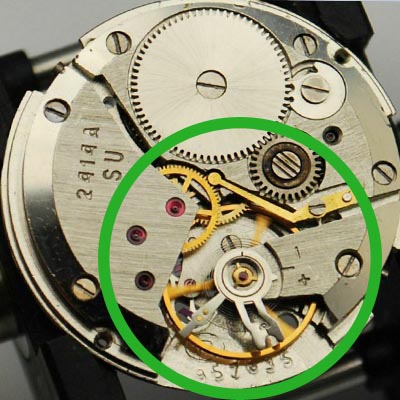
If you look to the other side of this area, you will see a little arm. This is the arm you need to move.
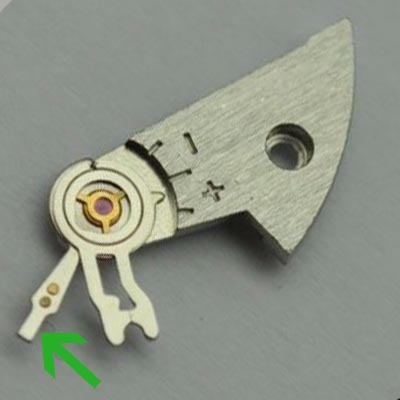
As you move this arm, the little pointer will move to either the + or –
Obviously move it in the direction you want to go. If your watch is too fast… slow it down by going more towards the – symbol. If your watch is going too slow, move the arrow towards the + to speed it up.
It is VERY important to know that you only need to move this arm a very small amount. The tiniest nudge will make a huge difference.
If you have other brands of watches, you will notice lot of them also have similar little markings in this same area, or even letters, such as S/F for fast/slow. How you actually regulate them will depend on what model they are, but a lot of them work in a similar way to how these Vostoks are set up.
So now you have barely moved this little arm. You can close the watch back up and assess the results.
Seeing The Results
If you have a timegrapher you can see the results instantly and can keep tweaking the arm with little movements until you are happy with the results. Once you are happy you can close the case back and enjoy your newly regulated watch.
If you don’t have a timegrapher then you will have to go back to the slow assessment that we did at the start.
Again, set the watch and record the time along with an accurate time. Give it 24hour again and hopefully now you see an improvement.
If you are still not happy with the speed the watch is running at, then you need to just repeat the same steps, open the back and give the little arm a nudge.
Yes, this process is slow, but it works and you will start to see your watch becoming more accurate. If you have a number of watches you want to do this too, a timegrapher could be worth the cost.
Angles
I think it is also important to note that watches will work slightly differently at different angles. If you watch is lying flat, it may run at a different speed compared to when it is laying face down, or sat up at 90’.
When I do these tests, I just leave the watch in the same position. I just lay it flat on the desk. However, this could be the worst angle for performance, or maybe it’s the best. When you wear the watch, your arm moves a lot and the angle is constantly changing, so you may find different results from wearing a watch than letting it sit on the table.
Also if it is an automatic, the movement of your wrist will wind the watch. Usually a watch that is well wound, will run more accurately, so this could also affect the results.
This is really why a timegrapher is the best option. You can quickly play around with the angles and get an immediate feedback on how the watch is responding.
Asking A Watch Maker To Do This
If you feel this is too difficult or just too much effort, you can go to any watchmaker and ask them to do this.
They will literally do the exact same thing as I have described above. They will of course have a Timegrapher and other tools, so they will be able to do this quickly and easily and I imagine for only a small fee.
(You can read more about – Are Vostok Watches Worth The Money?)
Conclusion
Regulating a Vostok is pretty simple and if you are not happy with its performance you can quickly and easily adjust it to run more accurately. Always remember that a mechanical watch will never be perfect, but you can usually get them run within a good range, usually a lot better than when it left the factory.
(You can read more about – Why Do People Love Vostok Watches?)

Ian is the main writer at Horology Dream and is a lover all things watch related.
He has been a watch collector for over a decade and brings his knowledge and experience to this site to help you on your own watch collecting journey.
You can connect with him on Social media and talk anything watches or read more about him on his Author Page.