Once you start getting into watches, you will very quickly realise there is a whole world of different styles, shapes, colours, types and functions available with watches.
Some collectors like to have one watch from each style category and they like to “tick the box” to say they have it. Others like to only focus on one style and collect a number of watches that are similar.
In this article I will go through the various categories that are available.
Gender
The first thing to note is that manufactures often make male and female variants of watches. Usually the female versions are smaller and then they go for the usual clichés of making the colours more feminine. You will see lots of whites or pinks along with diamonds and similar things to this.
The reality is watches can be unisex. A lot of brands just release one watch. We seem to label them as “mens” watches but really any one can and actually do wear them.
The same goes for the small pink and sparkly watches, just because it’s in the “woman’s” section doesn’t mean it’s only for them.
I wouldn’t worry about gender, just buy what you like and what fits your wrist and enjoy it.
Analogue And Digital Watches
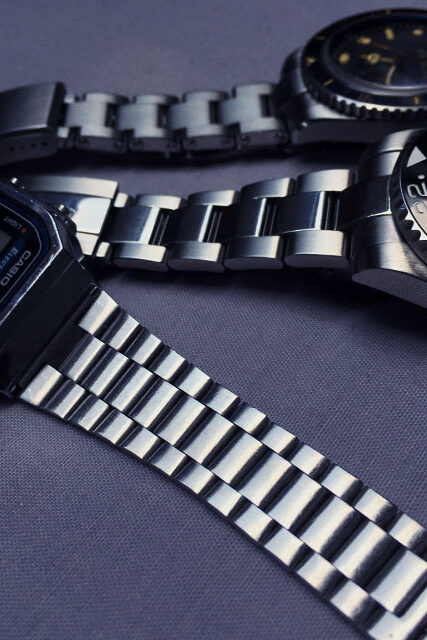
The first major difference to notice between watches is the display style. This is literally how you read the time on the watch.
The classic style is the analogue system. This is your typical hour and minute hand that move around to tell the time.
You then have digital watches, where it will show you the time on an LCD screen. This is normally displayed in numbers, but you can get some watches where they digitally show the hour and minute hands for you to read.
You can also get some watches that have both analogue and digital displays which allow you to read the time in both formats.
Quartz And Mechanical Watches
The next area is to know about is how the watch is powered. We sometimes forget that watches are little machines and need power to work.
The two main power sources are quartz and mechanical.
Mechanical Watches
Mechanical watches are the traditional type. They work by winding up the watch. Very simply there are a number of gears, cogs and springs that you wind up and as it all unwinds, it moves the hands, allowing you to tell the time. When you start to look at how these mechanisms work and how they reliably tell time it is fascinating.
Mechanical watches will require you to wind them up to keep them working. If you forget, your watch will stop.
Automatic Watches
Watch makers actually came up with a genius way to overcome the problem of having to constantly wind up mechanical watches. They were able to install a rotor disc into the watch that is weighed in a way that it will spin around when the wearer moves their arm. This is all connected to the various cogs and results in the watch being wound by this rotor disc moving around. All you have to do is wear the watch and it will wind itself.
You can still wind the watch in the traditional way if needed, or just let it do its thing automatically.
Quartz Watches
In the late 1960s the quartz watch was invented and its success nearly seen an end to mechanical watches.
A Quartz watches means that it is charged by batteries. An electrical current is sent into a quartz crystal that makes it vibrate. The frequency of this vibration (the oscillation) is used to calculate the time.
This is in the same way that a grandfather clock uses the swing of a pendulum (its oscillation) to regulate the time, or how in a mechanical watch has a balance wheel, which spins back and forth to regulate time… exactly like a pendulum and its oscillation.
Quartz crystals in conjunction with batteries allow for extremely accurate timekeeping as well as the fact that you do not need to do anything with the watch for a long time, it will just keep working accurately on its own. Of course occasionally the battery will die and need replaced, but this will be every few years which makes them highly convenient.
Quartz watches can be found in both analogue and digital displaying watches.
Solar Watches
Solar watches have small solar panels hidden within their dials. These charge up your watch and any extra charge is stored in a battery, basically meaning you will never run out of power for your watch and will not need to replace the battery.
Dislike of Quartz Wacthes
There is also a general vibe that quartz watches are inferior. While they are generally used in cheaper watches, they are actually more accurate at keeping the time compared to mechanical watches, even the high end luxury ones.
This general vibe of hate is just from watch snobs who feel mechanical watches are superior. While mechanical watches certainly have a special charm, there is nothing wrong with quartz.
Styles of Watches
Watches can generally be divided into the follow styles:
Dive Watch
These watches are water resistance, usually made from stainless steel and have either a bracelet or rubber strap. They will have their signature numbered bezel, which is designed to be used to time dives so you do not run out of oxygen.
The dials are also pretty simple, usually only having markers at the hour rather than numbers. However, they very legible and will have strong lume so you can read it clearly when you are in those dark murky waters.
Field Watch
You may also hear these called military watches. They are designed to be used by soldiers in “the field” and are also often called “trench watches”
They are quite plain and simple with good legibility and large numbers marking each hour. They then usually have an inner scale which has 24hour markings. They will be waterproof, but not to the same extreme depths as a dive watch.
Pilot Watches
These are similar to field watches, but a little larger. They were initially designed for fighter pilots to be able to quickly glance at time when flying.
You can also find models that have various numbers on the bezel to allow the pilot to make calculations such as how much fuel they have of how fast they are going.
You might need a little maths to use these, but if you’re a pilot you shouldn’t really have any trouble with that sort of thing.
Chronographs
A chronograph is a watch that has a stop watch feature. You will usually be able to recognise them very easily as they have three crowns.
One will be the usual one that is for winding the watch and setting the time. The other two will be to activate and stop the stopwatch and to also reset it.
They also often have a number of smaller dials that are used to track the time with the stop watch feature.
Sport Watches
You could argue that this is a broader style that covers a few other watches. Such as dive watches, but I feel it can be classed as its own category.
These are the watches that do it all. They are light, waterproof, robust and easy to read and are just perfect for anything really. They are often on bracelets, but can also work on leather straps. They also may have other functions such a calendar or day function.
Although a dive watch is a sports watch, it is more specialised as it even more water proof than the average sports watch.
Dress Watches
These are your “fancy” watches that you wear with a suit for special occasions. These watches are slim, small, simple and elegant and very understated.
You shouldn’t be wearing anything big and loud while at a formal event, so a dress watch is perfect for the occasion and should be able to slip under your shirt cuff with no bother.
They are usually found on a nice leather strap and it is not uncommon for them to be square or rectangle shaped, rather than the classic round. This change in shape can just add a little extra style and class to your outfit.
GMT Watches
These watches have an extra hour hand. This is always a different colour and is used to track a different time zone. You have the normal hands to tell the time where you are and then you set the GMT hand to be at the hour for whatever time zone you want to track.
A lot of these watches also have a numbered bezel with 24hour markings, which actually allows you to line it up in such a way that you can actually use it track a 3rd time zone.
These watches are great if you travel a lot or have family and friends overseas. You can quickly glance at your watch and see what the time is at their location.
24 Hour Dials
These are not very common as they are a little unusual. At a glance you might not notice anything different with these but when you look a little closer you will see the dial is numbered with 24 markings, not 12. This means that telling the time is a little strange.
Instead of the hour hand going around the dial twice during a 24 hour period, it only goes around once. This means that when it is 12noon, the hand is only half way round. This might not seem to strange until you realise that this means it looks like the time is 6 o’clock, when it is actually midday.
So you can see why these watches are not to popular, you can’t really glance at the time and check it, since it’s a little different to every other clock you have probably ever read.
These watches are designed for people who don’t get any natural light, so need a way to tell if it’s Am or Pm. Think spacemen or people in submarines.
This issue is easily resolved today with digital watches, which is why you do not see many of these around. I find them highly curious and quirky and an excellent addition to any collection.
Fashion Watches
Fashion watches get a hard time from watch collectors and I can see why. These are often cheap quartz watches that are very over priced, simply as they have a fashion brand logo on them.
Personally I’m not really interested in them; I think you can find other brands with more interesting history and innovation in their watches. However, they are a category of watches you should be aware exists.
Watches With Complications
You can class GMT and chronographs into this group, but really they can be on any type of watch. A complication just means the watch can do something extra on top of telling the time.
The most common ones are the date and day complications, however, they can very advanced such as being able to track the moon phases or tell you when it is day or night.
Other Type of watches
Pocket watches
These are actually older than wrist watches. The wrist watch was invented by soldiers during the First World War who started strapping their pocket watches to their wrists to make it easier to read when in battle.
This style of watch can still be found today, although are not as common as wrist watches.
Smart Watches
There is a debate about whether or not these are actually watches, but I guess they are a form of watch. The only real issue with these is that they will not last long term.
The technology industry moves fast and smart watches can very quickly become obsolete when the next model is released.
Conclusion
As you can see the world of watches is pretty vast. One watch can vary different to the next.
This means you can really dive into the different styles and start studying all the subtle differences and see what style interests you the most. Even within the categories I have mentioned there can be vast differences from watch to watch. I find this fascinating and I hope you do too.
(You can read more about – Should You Buy A Bronze Watch?)

Ian is the main writer at Horology Dream and is a lover all things watch related.
He has been a watch collector for over a decade and brings his knowledge and experience to this site to help you on your own watch collecting journey.
You can connect with him on Social media and talk anything watches or read more about him on his Author Page.